Comet Lemmon: See it now or wait 1,150 Years!
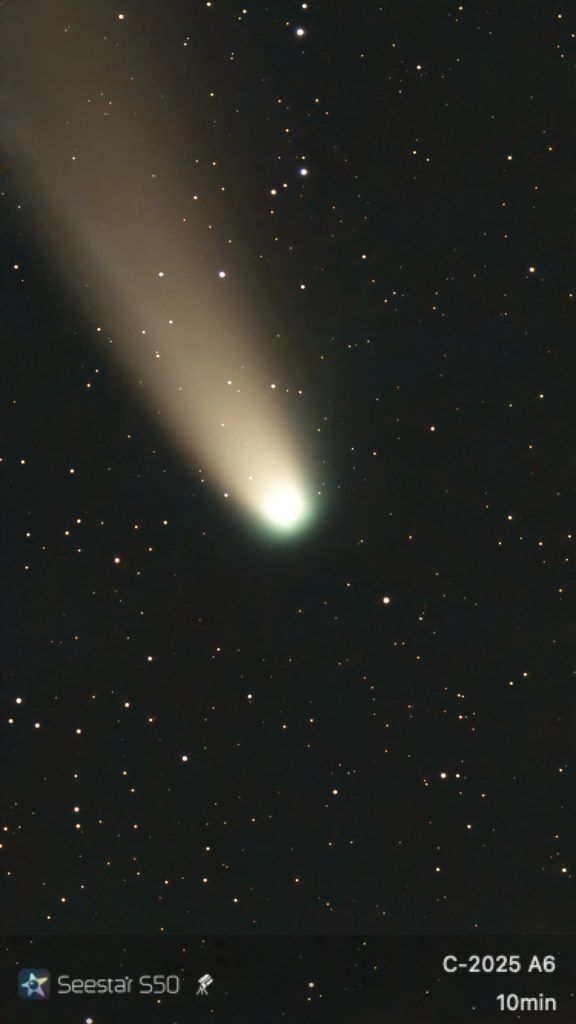
Discovery and Classification ☄️
- Official Name: The comet’s full designation is C/2025 A6 (Lemmon). The ‘C’ means it’s a non-periodic comet, and the ‘A6’ indicates it was the sixth object discovered in the first half of January 2025.
- Discovery: It was discovered on January 3, 2025, by astronomers using the Mount Lemmon Survey in Arizona, which is why it bears the “Lemmon” name.
- Type of Comet: It is a non-periodic or long-period comet, meaning it takes a very long time to orbit the Sun.
Orbit and Trajectory 🚀
- Orbital Period: Before its current pass, its inbound orbital period was estimated to be around 1,350 years. After rounding the Sun, gravitational influence (particularly from the Sun) will reduce the outbound period to about 1,150 years.
- Next Return: This means no one alive today is expected to see it again, as its next predicted return to the inner solar system is around the year 3175.
- Closest to Earth (Perigee): Its closest approach to Earth occurred on October 21, 2025, at a distance of about 0.60 Astronomical Units (AU), or about 90 million kilometers (56 million miles).
- Closest to the Sun (Perihelion): It will make its closest approach to the Sun on November 8, 2025, passing within about 0.53 AU (approximately 79 million kilometers).
Appearance and Visibility 👀
- “Green Comet” Hue: Comet Lemmon is known for its distinctive green glow, which is caused by the release of diatomic carbon (C2) that fluoresces when illuminated by the Sun’s ultraviolet light.
- Potential Brightness: It was predicted to reach a maximum apparent magnitude bright enough to be glimpsed with the naked eye (magnitude 4 or brighter) from dark, clear-sky locations around its closest approach in late October.
- Tails: The comet has displayed both a dust tail (reflecting sunlight, often slightly yellowish) and a blue ion tail (composed of gases ionized by solar wind).
- Best Viewing Location: For this pass, it has been best viewed by observers in the Northern Hemisphere, where it appeared in the evening sky after sunset around its brightest period.
Comet C/2025 R2 (SWAN), the most recent bright comet discovered by the instrument:
- Discovery Source: The comet was discovered by amateur astronomer Vladimir Bezugly on images from the SWAN (Solar Wind Anisotropies) camera, which is aboard the SOHO (Solar and Heliospheric Observatory) spacecraft.
- Discovery Date: It was officially discovered on September 11, 2025.
- Closest to the Sun (Perihelion): It passed closest to the Sun on September 12, 2025, at a distance of about $0.5$ Astronomical Units ($75$ million km).
- Closest to Earth (Perigee): Its closest approach to Earth occurred on October 20, 2025, at a very close distance of about $0.26$ Astronomical Units ($39$ million km).
- Visibility: Due to its close approach to Earth, it brightened considerably and was estimated to reach a magnitude that made it visible with binoculars and potentially faintly to the naked eye under dark skies.
- Color/Appearance: Like many comets, it exhibits a noticeable greenish hue from the diatomic carbon in its coma, and developed a prominent tail.
- Orbital Period: It is a long-period comet with a highly elliptical orbit, estimated to take hundreds to thousands of years to complete one full trip around the Sun.
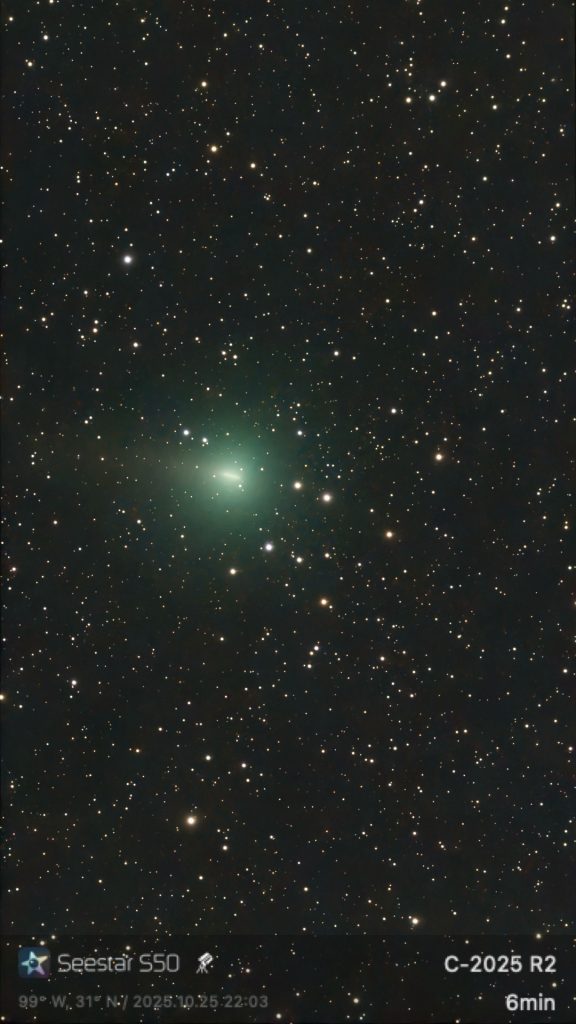
Comet C/2025 R2 (SWAN), the most recent bright comet discovered by the instrument:
- Discovery Source: The comet was discovered by amateur astronomer Vladimir Bezugly on images from the SWAN (Solar Wind Anisotropies) camera, which is aboard the SOHO (Solar and Heliospheric Observatory) spacecraft.
- Discovery Date: It was officially discovered on September 11, 2025.
- Closest to the Sun (Perihelion): It passed closest to the Sun on September 12, 2025, at a distance of about $0.5$ Astronomical Units ($75$ million km).
- Closest to Earth (Perigee): Its closest approach to Earth occurred on October 20, 2025, at a very close distance of about $0.26$ Astronomical Units ($39$ million km).
- Visibility: Due to its close approach to Earth, it brightened considerably and was estimated to reach a magnitude that made it visible with binoculars and potentially faintly to the naked eye under dark skies.
- Color/Appearance: Like many comets, it exhibits a noticeable greenish hue from the diatomic carbon in its coma, and developed a prominent tail.
- Orbital Period: It is a long-period comet with a highly elliptical orbit, estimated to take hundreds to thousands of years to complete one full trip around the Sun.
I would be happy to repeat all the information we discussed about Comet C/2025 A6 (Lemmon), compiled into the various sections we developed for your live presentation.
☄️ Overview: Comet C/2025 A6 (Lemmon)
I. 🔍 Introduction: What is This Comet?
• Official Name: Comet C/2025 A6 (Lemmon).
• Discovery: Discovered in January 2025 by the Mount Lemmon Survey in Arizona.
• Rarity: This is a long-period comet originating from the Oort Cloud, the spherical reservoir of icy bodies far beyond the orbit of Neptune.
• Significance: It is a pristine “time capsule,” carrying ices and dust unchanged since the formation of the Solar System 4.6 billion years ago.
• Orbital Period: Its incoming orbital period was approximately 1,350 years. After its pass by the Sun, solar gravity will reduce its period, but its next visit will still not be until around the year 3175.
II. 🗺️ How to Find It Tonight (October 28, 2025)
• When to Look: Look in the evening sky, shortly after astronomical twilight ends (when the sky is fully dark).
• Where to Look: Look low on the northwestern horizon.